NHSS Sector 16 Explained: Why It Matters When Choosing a Surfacing Contractor
If you procure surfacing work — for a council, a main contractor or a commercial site — NHSS Sector 16 is the accreditation that should be at the top of your checklist. Here is what it means, in plain English.
What Are the National Highway Sector Schemes?
The National Highway Sector Schemes (NHSS) are quality management schemes developed for the UK highways industry. Each scheme takes the internationally recognised ISO 9001 quality standard as its foundation and adds detailed, sector-specific requirements for a particular type of highway work — from traffic management to road markings to the laying of asphalt.
The thinking behind the schemes is simple. A generic quality certificate tells you that a company has a documented management system, but it does not tell you whether that company can actually lay asphalt properly. The sector schemes close that gap. They interpret ISO 9001 for a specific trade, so that when a certification body audits a contractor, it is assessing the things that genuinely determine the quality of the finished road: the competence of the people, the control of the process and the records that prove it.
Certification is issued by independent, accredited certification bodies — not by the contractor itself. That independence is the whole point: a third party has examined how the contractor really works, and keeps checking through ongoing audits.
What Does NHSS Sector 16 Specifically Cover?
Sector 16 is the National Highway Sector Scheme that covers the laying of asphalt mixes. It applies to the site-based activity of surfacing itself — the planning, preparation and placement of asphalt on roads and other paved areas — and it defines how a surfacing contractor's quality management system must address that work.
It matters most on the strategic road network. Asphalt laying on motorways and major trunk roads must be carried out by contractors certified to Sector 16, which is why it is regarded as the benchmark accreditation for road surfacing in the UK.
That has a useful consequence for everyone else. Councils resurfacing local roads, main contractors building estate roads to adoption standard, and commercial clients surfacing car parks and yards are not always obliged to use a Sector 16 contractor — but when they do, their project benefits from exactly the same audited processes, trained operatives and quality controls that the strategic road network demands.
What Does Sector 16 Certification Actually Involve?
Certification is not a form-filling exercise. To gain and keep a Sector 16 certificate, a surfacing contractor must keep demonstrating that its quality system works in practice. In broad terms, that means:
Independent audits — the contractor's management system and site operations are assessed by an accredited certification body, with ongoing surveillance audits to retain certification.
Trained, competent operatives — the people laying the asphalt must be able to demonstrate appropriate training and competence for their roles, with records to prove it.
Documented processes — clear, written procedures covering how surfacing work is planned, controlled and checked, so quality does not depend on guesswork or individual habit.
Records and traceability — evidence of what was laid, where and how, giving clients an audit trail behind the finished surface.
Continuous improvement — the ISO 9001 backbone requires non-conformances to be identified, corrected and learned from, year after year.
In other words, a Sector 16 certificate is ongoing proof that a contractor's quality claims have been tested by an independent auditor — not just written into a brochure.
Why Clients Should Ask for Sector 16
For councils and highway authorities, specifying a Sector 16 certified contractor means resurfacing schemes are delivered by a firm already audited against the standard used on the country's most demanding roads. It simplifies due diligence and gives elected members and residents an independent answer to the question "who checked this contractor?"
For main contractors, a certified surfacing subcontractor de-risks the package. Estate roads built for adoption, Section 278 works and infrastructure projects all end up inspected by a highway authority — and surfacing laid under an audited quality system is far less likely to generate defects, remedials and programme delays.
For commercial clients — car parks, distribution yards, business parks — Sector 16 is a quick, reliable filter in a market where anyone with a lorry can call themselves a surfacing contractor. Asphalt failures are expensive to put right. Certification tells you the contractor's processes have been independently verified before a single tonne is laid.
Certified Since Day One Mattered
Stardom Ltd has been surfacing roads since 1993 and holds NHSS Sector 16 certification. That combination is what de-risks a project: three decades of laying asphalt in the real world, with processes independently audited against the industry's benchmark scheme.
NHSS Sector 16 certified for the laying of asphalt mixes
Established 1993 — 30+ years of surfacing expertise
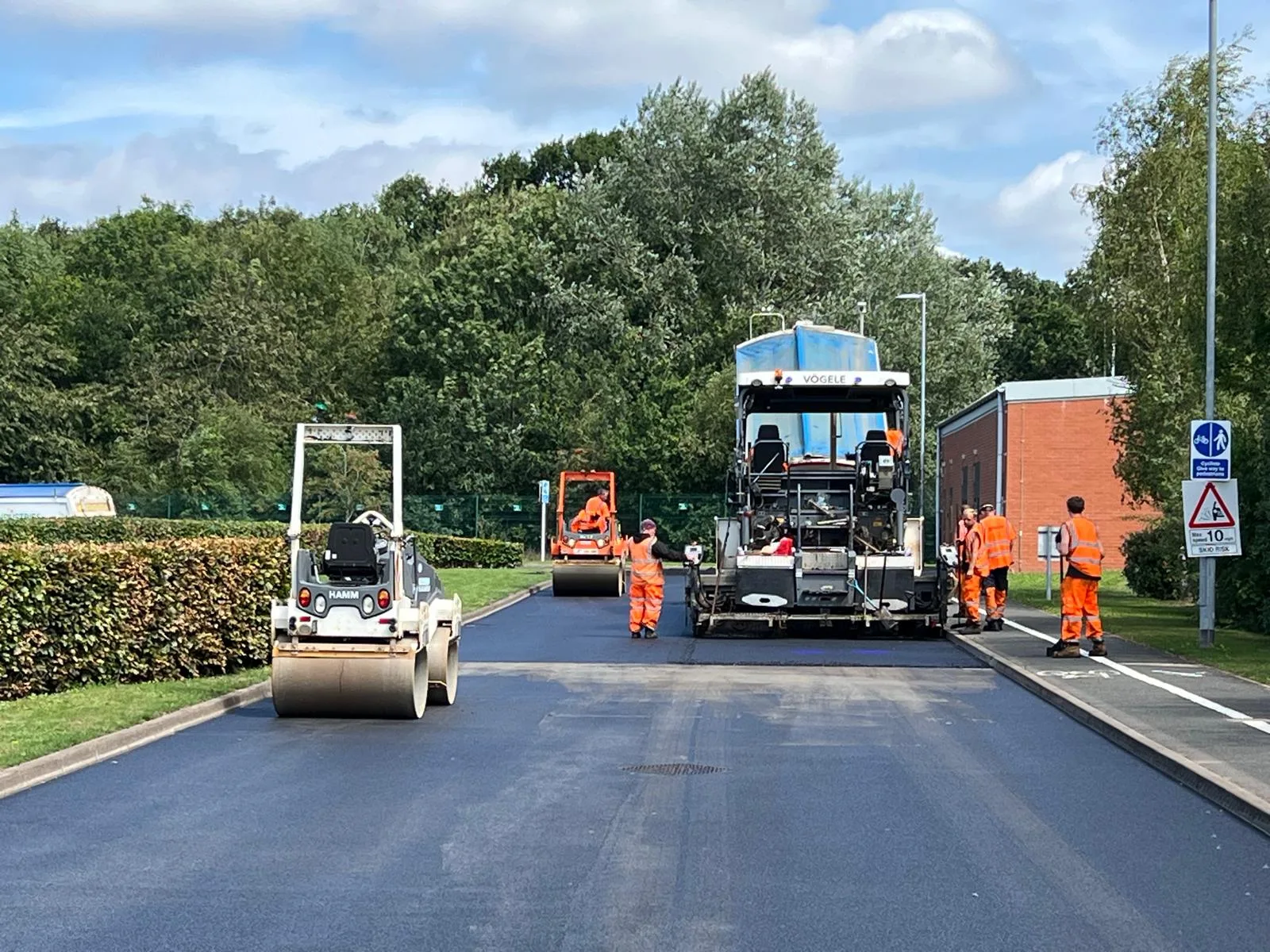
Modern Vögele paver fleet for consistent, high-quality mats
Nationwide coverage from our Nuneaton headquarters
Trained, experienced surfacing crews with documented competence
Whether your project is a motorway-standard scheme or a commercial car park, you get the same audited processes, the same trained crews and the same Vögele-laid finish. See our road surfacing services for what we deliver day to day.
NHSS Sector 16 — Frequently Asked Questions
What does NHSS stand for?
NHSS stands for National Highway Sector Schemes. These are quality management schemes for the UK highways industry, built on the ISO 9001 standard but with additional, sector-specific requirements. Each scheme covers a particular area of highway work — Sector 16 covers the laying of asphalt mixes.
What does NHSS Sector 16 cover?
NHSS Sector 16 covers the laying of asphalt mixes. It sets out how an asphalt contractor's quality management system should work in practice — including documented processes, competent and trained operatives, and independent auditing — so that asphalt is laid consistently and to a verifiable standard.
Is NHSS Sector 16 required for all surfacing work?
Sector 16 certification is required for asphalt laying on the strategic road network — motorways and major trunk roads. For other work, such as council highways, car parks or private developments, it is not always mandatory, but many clients specify it because it provides independent assurance of quality. Choosing a Sector 16 certified contractor means the same audited standards apply to your project.
How is NHSS Sector 16 different from standard ISO 9001?
ISO 9001 is a general quality management standard that applies to any industry. NHSS Sector 16 builds on ISO 9001 and adds requirements specific to laying asphalt, so the audit looks at how the contractor actually performs surfacing work — not just its paperwork. A generic ISO 9001 certificate alone does not demonstrate the same depth of surfacing-specific scrutiny.
Is Stardom Ltd NHSS Sector 16 certified?
Yes. Stardom Ltd is NHSS Sector 16 certified and has been delivering surfacing since 1993. We operate a fleet of Vögele pavers and work nationwide from our Nuneaton headquarters at Construction House, Trident Business Park, Holman Way, Nuneaton CV11 4PN. Call 02476 750 033 to discuss your project or request a free quotation.
Want a Sector 16 certified contractor on your next project? Call 02476 750 033 or request a free quote
Work With an NHSS Sector 16 Certified Contractor
Independent audits. Trained crews. Documented quality. Stardom Ltd brings 30+ years of certified surfacing expertise to projects nationwide. Free, no-obligation quotations.
Get a Free Quote